Share
Eight Special Mission Vehicles of the Ministry of Finance are building an integrated candlenut ecosystem from upstream to downstream to create greater value, increase farmers’ incomes, and expand export markets.
Mataram, September 25, 2026 – The Ministry of Finance, through the Directorate General of State Assets (DJKN), continues to strengthen the role of Special Mission Vehicles (SMVs) as part of the State’s assets in creating greater value for the economy and society. Since 2022, DJKN has initiated collaboration among all SMVs to implement Corporate Social and Environmental Responsibility (TJSL) programs, leveraging their respective roles and expertise to deliver broader benefits to communities.
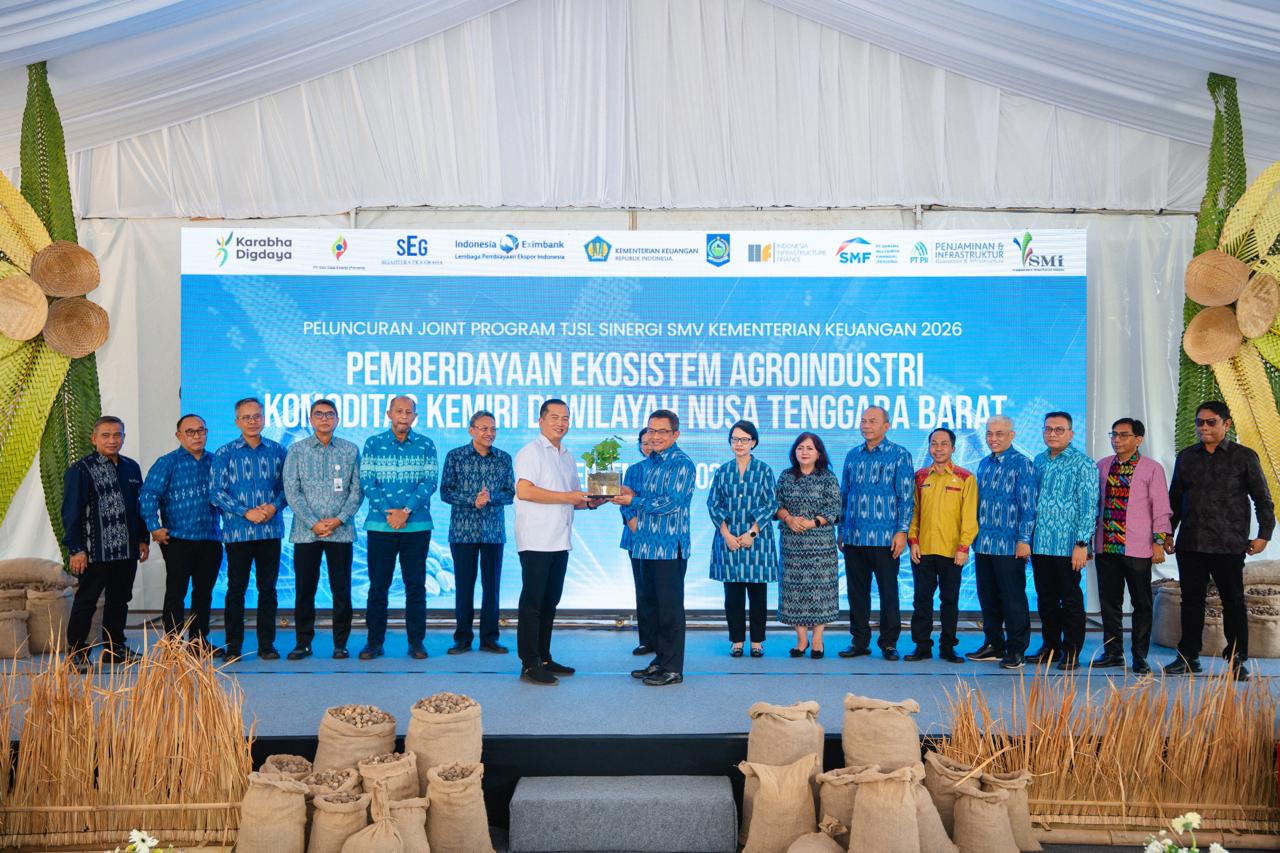
This collaboration is realized through the 2026 Ministry of Finance SMV Synergy TJSL Program, themed “Empowering Sustainable and Export-Oriented Candlenut Commodities in the Candlenut Export Village of West Nusa Tenggara (NTB)”, which was officially launched in Mataram on Thursday (September 24).
The program covers 40 villages and 350 beneficiary farmers, encompassing approximately 7,836 hectares of land and annual candlenut production of around 120 tons. The interventions are carried out in an integrated manner, ranging from seedling distribution and farmer capacity building to the development of production centers, post-harvest modernization, the utilization of solar energy, and the development of downstream products such as candlenut oil and briquettes.
Indonesian Minister of Finance Suahasil Nazara said that developing regional potential is an important part of expanding sources of national economic growth. The Central Government acts as an enabler to accelerate the development of regional economic potential, so that regions are not merely beneficiaries of development but can also become sources of economic growth.
“I am pleased to see such a strong spirit of synergy in NTB. This spirit is aligned with NTB’s development vision, ‘Rising Together Towards a Prosperous and Globally Connected Archipelagic NTB.’ SMVs are here to initiate, strengthen capacity, build ecosystems, and open access. Once the model has been established and economic activities are up and running, the Regional Government, communities, and business actors are expected to continue and scale up the initiative,” the Minister of Finance said in a statement delivered by the Ministry of Finance’s Expert Staff, Dwi Teguh Wibowo.
The eight SMVs contribute according to their respective mandates and areas of expertise. LPEI/Indonesia Eximbank supports post-harvest processing and the provision of equipment to support candlenut-based products; PT Penjaminan Infrastruktur Indonesia (PT PII) strengthens farmer capacity in Lombok, Sumbawa, and Bima; while PT Sarana Multi Infrastruktur (PT SMI) supports candlenut seedling cultivation.
PT Sarana Multigriya Finansial (PT SMF) supports the development of production centers, PT Geo Dipa Energi (PT GDE) installs solar panels, and PT Karabha Digdaya supports post-harvest management. Meanwhile, Indonesia Infrastructure Finance (IIF) and PT Sejahtera Eka Graha are developing downstream products such as briquettes and candlenut oil.
Governor of West Nusa Tenggara Lalu Muhamad Iqbal said that the collaboration is expected to increase the added value of the commodity while delivering greater economic benefits to local communities.
“Candlenut is one of NTB’s potentials that can be developed to create greater added value. This collaboration is important to ensure that its development does not stop at production, but is connected from upstream to downstream and is able to reach global markets. We hope that the ultimate benefits will return to the community through increased productivity, higher farmer incomes, and the growth of economic activities in the region,” Iqbal said.
LPEI Executive Director Sukatmo Padmosukarso said that the SMV synergy is expected to build an increasingly robust candlenut ecosystem in NTB, from strengthening production capacity to opening access to global markets. As an institution mandated to promote national exports, LPEI plays a role in strengthening the readiness of products and business actors to meet export market requirements.
“Candlenut from NTB has the potential to be developed into a value-added export commodity. The challenge is how to connect potential at the farmer level with global market requirements in terms of quality standards, processing, and market access. Through SMV synergy, we aim to build a stronger value chain so that the benefits of exports are reflected not only in increased transactions, but are also felt by farmers and local communities,” Sukatmo said.
Based on field studies and assessments conducted by the Insan Bumi Mandiri Foundation, the program is expected to increase the number of participating farmers in Lombok, Sumbawa, and Bima to 550–720 farmers, while gradually increasing production to 2,400–3,600 tons per year. Farmers’ incomes are targeted to increase by 20–25 percent, while production efficiency is expected to improve by 60–70 percent. The program is also expected to add 3–6 export destination countries and increase the local economic value by approximately Rp30 billion–Rp40 billion per year.
The launch series also featured the signing of a Memorandum of Understanding (MoU) between LPEI and the Government of West Nusa Tenggara on the development of export-oriented MSME capacity. LPEI also presented the NTB Export Potential Book, which contains an assessment of the region’s leading commodities with potential for development in global markets.
The event also featured the symbolic handover of candlenut seedlings and the ceremonial release of exports of NTB’s leading commodities, including candlenut destined for Japan, with potential market opportunities in Singapore, as well as 1.4 tons of vanilla destined for the United States, valued at Rp3.8 billion. A showcase of leading products from 16 business enterprises supported by SMVs in NTB was also held as part of the event.
On the occasion, LPEI also signed a Memorandum of Understanding (MoU) with the Government of West Nusa Tenggara (NTB) to strengthen the competitiveness of the region’s exports. The MoU covers commitments to cooperation and synergy between LPEI and the Government of NTB in developing the capacity of export-oriented small and medium-sized enterprises (SMEs), cooperatives, and village-owned enterprises (BUM Desa) in NTB.
According to a study by the IEB Institute, Indonesia’s candlenut exports reached US$9.58 million in January–September 2025. In 2024, Indonesia ranked 13th among the world’s candlenut exporters, accounting for approximately 0.5 percent of global exports. Bangladesh and Malaysia were the two main export markets, jointly accounting for 64 percent of Indonesia’s candlenut exports.
At the same time, opportunities to expand into new markets remain open. China, the United States, Vietnam, Germany, and the Netherlands have been identified as markets with untapped export potential. Therefore, improving product quality and consistency, modernizing processing capabilities, and strengthening market access are essential components of developing NTB’s candlenut industry.
The development of NTB’s candlenut exports can be directed toward increasing added value, strengthening quality, and expanding market access. Candlenut has potential as a spice commodity and as a raw material for the food industry, particularly for seasonings, sauces, processed foods, and vegetable oils.
However, to compete more effectively in export markets, NTB candlenut should not be marketed solely as a raw commodity. It needs to be further developed into more industry-ready value-added products, such as shelled candlenuts, roasted candlenuts, candlenut powder, seasoning paste, and candlenut oil.
Media Liason
Corporate Secretary – Lembaga Pembiayaan Ekspor Indonesia
Ph. : (021) 39503600
Email : corpsec@indonesiaeximbank.go.
Web : http://www.indonesiaeximbank.
 en
en  id
id